| 1 | Understand the core composition | WPC panels are generally made from wood flour or wood fiber, a thermoplastic polymer such as PVC, PE, or PP, plus stabilizers, pigments, lubricants, and other additives. | Wood content and polymer content vary by formulation. Higher wood content may provide a more wood-like appearance, while the polymer matrix contributes moisture resistance and dimensional stability. | Request the technical data sheet and confirm the declared composition, recycled content, and whether the panel contains restricted substances. | Living rooms, corridors, bedrooms, and decorative feature walls |
| 2 | Select an appropriate panel thickness | Indoor decorative WPC wall panels are commonly available in thicknesses of approximately 5–25 mm, depending on the profile and reinforcement design. | Thicker panels generally provide greater rigidity and can better conceal minor wall unevenness, but they may increase weight and installation cost. | Compare thickness, panel weight, support spacing, flatness tolerance, and the condition of the wall substrate. | 5–10 mm for decoration; 12–25 mm for more rigid systems |
| 3 | Check density and structural stability | WPC density depends on the polymer, wood-fiber ratio, foaming level, and profile structure. Solid and foamed panels can have noticeably different weights. | A heavier solid panel may offer better impact resistance, while a foamed or hollow profile can reduce weight and simplify handling. | Review density or weight per square meter, bending strength, impact resistance, and recommended fixing method instead of judging quality by appearance alone. | High-traffic hallways, office interiors, and residential feature walls |
| 4 | Evaluate moisture resistance | The polymer component limits water absorption compared with many untreated wood products, but exposed cut edges, joints, and backing layers may still absorb moisture. | WPC is generally suitable for humid indoor environments when the product is designed and installed correctly. It should not automatically be treated as fully waterproof. | Look for water-absorption data, edge-sealing instructions, compatible adhesives, and restrictions for areas exposed to direct water or persistent condensation. | Kitchens, utility areas, and ventilated bathrooms outside direct shower zones |
| 5 | Confirm fire-performance requirements | WPC contains combustible organic material and may require flame-retardant additives or a tested multilayer construction to meet specific interior requirements. | Fire classification is product-specific. A panel should be assessed according to the applicable local building code and test method, rather than by material name alone. | Ask for a current fire-test report, classification, test standard, mounting method, and substrate details that match the intended installation. | Commercial interiors, public corridors, hospitality, and residential projects |
| 6 | Assess thermal expansion | Thermoplastic-based panels expand and contract with temperature changes. The movement depends on polymer type, panel length, installation temperature, and fixing system. | Long panels may require perimeter gaps, expansion joints, clips, or battens. Dark colors can become warmer under strong sunlight and may experience greater movement. | Follow the stated expansion coefficient, maximum panel length, joint width, and installation-temperature requirements. | Interior walls with stable temperatures; use extra planning near windows or heat sources |
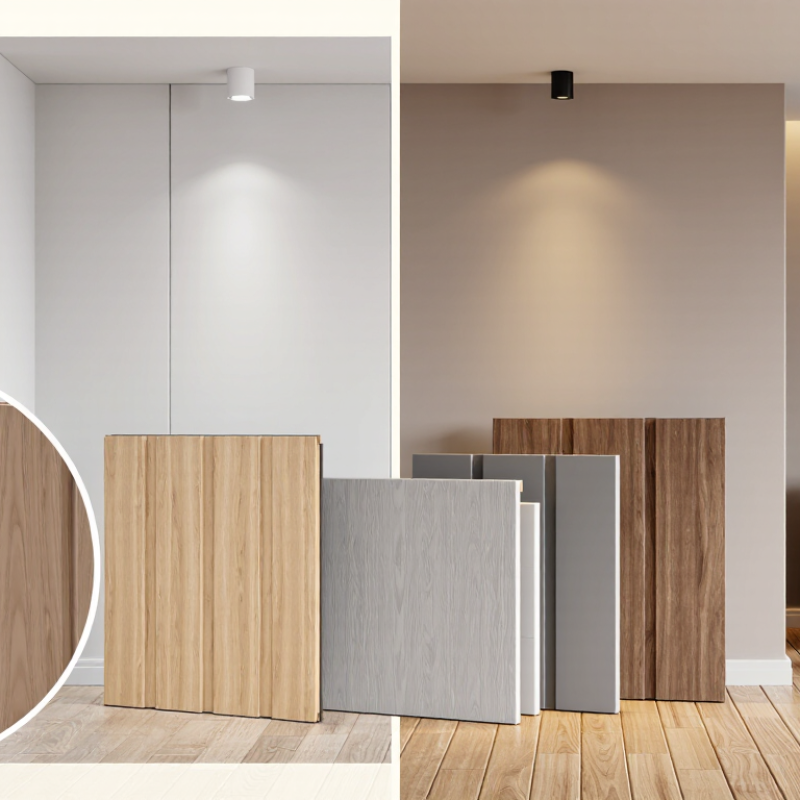
| 7 | Choose the right surface finish | Common finishes include wood grain, matte, embossed, brushed, painted, laminated, and co-extruded surfaces. | Textured finishes can disguise minor marks and create visual depth, while smooth finishes are easier to wipe but may show fingerprints, dust, or scratches more clearly. | Inspect a physical sample for color consistency, gloss level, texture depth, scratch resistance, and variation between production batches. | Decorative walls, reception areas, bedrooms, restaurants, and retail interiors |
| 8 | Review cleaning and stain resistance | A sealed or co-extruded surface generally provides easier routine cleaning than an unsealed porous wood surface. | Most indoor panels can be cleaned with a soft cloth and mild detergent. Strong solvents, abrasive pads, and prolonged standing water may damage the finish. | Verify the approved cleaning agents, stain-removal procedure, surface hardness, and warranty exclusions related to chemicals or abrasion. | Dining areas, offices, family rooms, and other regularly used spaces |
| 9 | Consider indoor air quality | Indoor environmental performance depends on the polymer, wood material, adhesives, coatings, pigments, and manufacturing process. | Low-emission documentation can help reduce concerns about volatile organic compounds. Formaldehyde performance should be verified separately if wood-based binders or composite backing materials are used. | Request VOC-emission test results, formaldehyde information where relevant, safety data, and documentation for the complete panel system. | Bedrooms, schools, healthcare spaces, offices, and environmentally focused projects |
| 10 | Check installation and end-of-life factors | Panels may be installed with adhesive, screws, clips, furring strips, or interlocking profiles. Removal and recyclability depend on the product construction and attached finishes. | Lightweight profiles can reduce installation effort, while mechanical fixing may improve removability. Mixed materials, coatings, and adhesives can make recycling more difficult. | Confirm substrate preparation, cutting tools, joint details, replacement-panel availability, packaging waste, and disposal or recycling guidance. | Renovations, modular interiors, rental properties, and long-term fit-out projects |