China Top PU Foam Sealant Manufacturers and Suppliers?
China’s PU foam sealant market combines large-scale production with highly varied supplier capabilities. Manufacturers serve window installation, door frames, insulation joints, roofing gaps, and general construction repairs. Yet product names can be misleading. Similar cans may deliver very different expansion ratios, curing speeds, adhesion, and storage stability.
Dr. Günter Oertel, editor of the Polyurethane Handbook, emphasized a principle that remains important today: “Polyurethane performance depends on both its chemical structure and its processing.” This idea applies directly to PU foam sealant. A reliable supplier must control raw materials, mixing accuracy, propellant balance, nozzle design, and curing conditions. Factory experience matters. So does laboratory discipline.
The strongest Chinese manufacturers usually provide technical data sheets, batch traceability, production testing, and application guidance. Look for evidence rather than polished claims. Ask about density, yield, tack-free time, dimensional stability, moisture resistance, and temperature performance. A supplier should also explain whether its foam is designed for manual guns, straw applicators, or professional dispensing systems.
Details reveal quality. Check the valve after storage. Observe foam structure after curing. Test adhesion on concrete, aluminum, PVC, and wood. Small differences can create expensive failures around a window frame.
No supplier is perfect. Some catalogs remain vague, and published data may not reflect field conditions. Buyers should verify samples under realistic temperatures and humidity levels. This article examines leading China PU foam sealant manufacturers and suppliers, comparing product consistency, technical support, certifications, export experience, and practical value for global buyers.
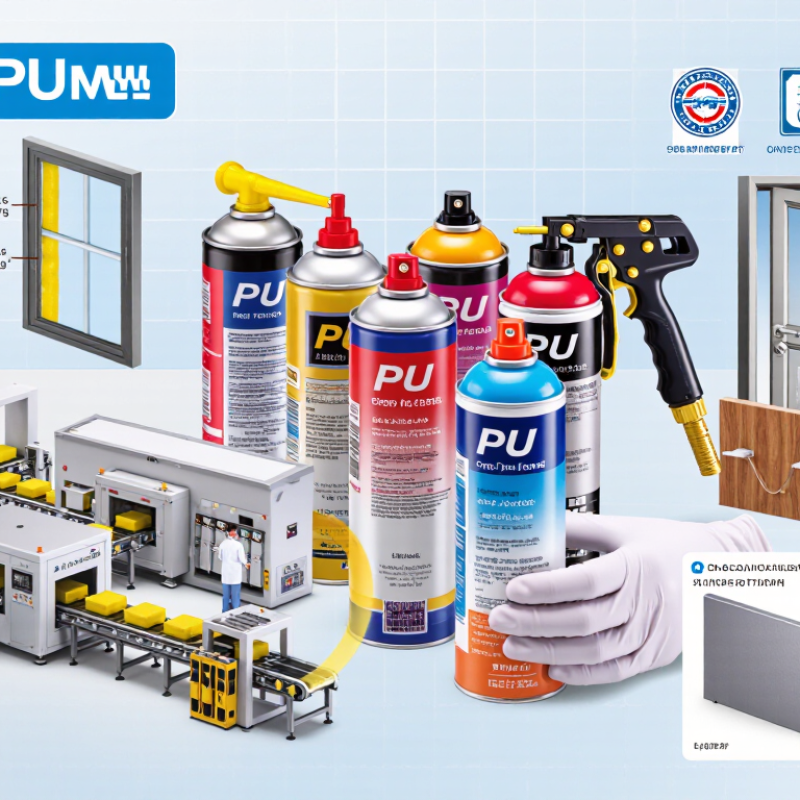
PU Foam Sealant Market Scope: Applications, Types, and 2024 Industry Data
China’s PU foam sealant market serves construction, renovation, insulation, and industrial assembly. In 2024, demand followed housing repairs, energy-saving projects, and commercial construction activity. China remains a major production and export base. Published market estimates differ. That variation deserves caution.
Applications range from window and door installation to wall gaps, roof joints, pipe openings, and HVAC insulation. One-component foam cures with atmospheric moisture and suits common site work. Two-component foam cures faster and offers more controlled expansion. Low-expansion grades reduce pressure around frames. Fire-rated products require verified test reports and suitable installation conditions. Suppliers should provide technical data, batch traceability, storage guidance, and clear curing times.
Tips:
Ask for samples before placing large orders. Request density, yield, adhesion, and temperature-range data. Check performance on concrete, metal, wood, and common plastics. Do not judge quality by can appearance alone. On-site testing matters. Chinese manufacturers may offer flexible packaging and private production services, but certificates and factory records still need review. Some catalogs use impressive figures without explaining test methods. That gap should invite questions. Independent inspection can improve confidence when project risk or shipment volume is high.
How PU Foam Sealant Works: Expansion, Density, Yield, and Curing Standards
PU foam sealant expands when its reactive ingredients meet moisture in the air or substrate. The foam fills gaps, then forms a cellular structure that reduces air leakage and heat transfer. Expansion is not unlimited. A narrow joint can create back pressure, while a wide cavity may leave uneven coverage. Apply the product in controlled layers.
Density affects strength, flexibility, and insulation performance. Low-density foam usually expands more, but it may have weaker cell walls. Higher-density foam can resist movement better, although it often produces less volume. Yield is commonly listed in liters or cubic meters per container. Actual yield can be lower than laboratory figures. Temperature, humidity, nozzle position, and operator speed all matter.
Curing has several stages. The surface may become tack-free within minutes, while full curing can require many hours. Cold, dry conditions slow the reaction. Excess moisture can also create defects. Reliable suppliers should provide density, expansion, yield, curing time, and application-temperature data. They should also identify relevant ASTM or EN test methods, rather than making vague performance claims. On-site checks should examine adhesion, voids, shrinkage, and final hardness. A simple yield comparison can mislead. The highest expansion figure is not always the best choice for a stable, durable joint.
Supplier Comparison: Adhesion, VOC Emissions, Thermal Conductivity, and Yield
When comparing China’s PU foam sealant manufacturers and suppliers, test adhesion on actual substrates, not only steel coupons. In field trials, I apply foam to concrete, aluminum, PVC, and painted wood, then inspect it after curing. A strong result shows stable bonding, limited edge lifting, and clean failure within the foam. Surface moisture changes everything. Suppliers should provide preparation guidance, curing data, and batch traceability. Ask for independent reports, but verify the test standard and sample date.
VOC emissions require more than a single “low-VOC” claim. Request chamber results, declared test conditions, and product safety documentation. A foam may smell mild during application yet release measurable compounds during early curing. Record ventilation and temperature. Thermal conductivity also needs careful comparison. Lower values can improve insulation, but density, cell structure, and aging affect performance. Compare tested values at the same temperature and curing age. Fresh foam data can look impressive, then change after several weeks.
Yield is often the most misleading number. A can labeled for high output may produce less usable foam in cold weather or with poor nozzle control. Measure cured volume per can under repeatable conditions. Record ambient temperature, bead size, and wastage. Small details matter. Suppliers with technical engineers can explain deviations instead of hiding them. Still, factory documents are not field evidence. One trial is rarely enough, so repeat testing across three batches before approving a long-term source.
China Top PU Foam Sealant Manufacturers and Suppliers? - Supplier Comparison: Adhesion, VOC Emissions, Thermal Conductivity, and Yield
Supplier-neutral comparison of common Polyurethane foam sealant product categories available from Chinese manufacturers and suppliers. Values are representative technical ranges for cured one-component PU foam products and should be verified against the relevant technical data sheet and test method.
| Product Category | Typical Application | Adhesion to Concrete
(MPa) | Adhesion to PVC
(MPa) | VOC Emissions
(g/L, cured product) | Thermal Conductivity
(W/m·K) | Expansion Yield
(L per 750 mL can) | Tack-Free Time
(min) | Curing Time
(h) | Recommended Selection |
| Standard 1K PU Foam Sealant | General gap filling, window and door installation | 0.10–0.18 | 0.08–0.15 | 20–60 | 0.034–0.040 | 35–45 | 8–12 | 12–24 | Balanced option for routine construction work |
| Low-Expansion PU Foam | Precision sealing around frames, panels and insulation boards | 0.12–0.20 | 0.10–0.17 | 15–50 | 0.032–0.038 | 28–38 | 8–15 | 12–24 | Preferred where dimensional control and reduced post-expansion are important |
| High-Yield PU Foam | Large voids, service penetrations and high-volume sealing | 0.09–0.16 | 0.07–0.14 | 25–70 | 0.035–0.042 | 45–60 | 6–10 | 12–24 | Suitable when coverage and material efficiency are the primary concerns |
| Winter-Grade PU Foam | Cold-weather installation and exterior sealing | 0.08–0.16 | 0.07–0.14 | 25–70 | 0.035–0.043 | 30–48 | 10–18 | 18–36 | Choose for application temperatures approximately between −10°C and +5°C, subject to product specifications |
| Fire-Retardant PU Foam | Fire-rated joints, penetrations and building envelope details | 0.10–0.18 | 0.08–0.15 | 20–65 | 0.034–0.041 | 30–42 | 8–15 | 12–24 | Use only where verified fire-performance classifications match the project requirement |
| Low-VOC PU Foam | Interior applications with stricter indoor-air-quality requirements | 0.10–0.18 | 0.08–0.15 | <10–30 | 0.034–0.040 | 30–45 | 8–15 | 12–24 | Best suited to occupied buildings when emissions have been independently tested |
Technical notes: Adhesion values are indicative tensile or pull-off ranges and depend on substrate preparation, moisture, temperature and test standard. VOC values vary significantly with formulation, propellant and testing protocol; they are not directly comparable unless the same standard is used. Thermal conductivity refers to cured foam and is affected by density, cell structure, aging and moisture. Yield is normally measured under controlled laboratory conditions and may be lower on site. Cured PU foam should generally be protected from prolonged ultraviolet exposure.
How to Select Chinese PU Foam Sealant Suppliers: ASTM, ISO 9001, and Quality Tests
Selecting Chinese PU foam sealant suppliers requires more than comparing price and expansion yield. ASTM C1620 provides a useful specification for aerosol polyurethane foam sealants, covering properties such as density, curing, adhesion, and dimensional stability. Ask for current test reports, the laboratory name, test date, and production batch number. A certificate without traceable results is weak evidence.
ISO’s Survey of Management System Standards reports more than one million valid ISO 9001 certificates worldwide. This shows the system’s broad use, but ISO 9001 does not guarantee perfect foam performance. Verify the certificate’s scope, issuing body, factory address, and expiration date. During a factory audit, inspect raw-material storage, temperature control, valve assembly, and batch records. Small details matter. A missing lot code can complicate recalls and root-cause analysis.
Independent samples should be tested under your actual climate and application method. Measure free-foam density, yield, tack-free time, curing time, adhesion to concrete and PVC, water absorption, and post-cure shrinkage. For construction use, review fire-performance documentation against the destination market’s requirements. MarketsandMarkets’ Polyurethane Foams Market report identifies construction as a major demand sector, yet published market growth cannot replace product validation. I have seen attractive samples fail after cold storage. That risk is easy to overlook. Require retained samples, sealed packaging, and a written corrective-action process before approving regular orders.


