In 2026, global buyers will assess more than price when selecting a rock wool sandwich panel. They will examine fire performance, thermal resistance, moisture control, load capacity, and documented manufacturing quality. This matters because buildings remain major energy users worldwide. The International Energy Agency reported that buildings accounted for about 30% of global energy demand and 26% of energy-related emissions in 2022. Insulated envelopes can support lower operational energy use, but only when panels are correctly designed and installed.
Safety is equally important. The 2023 Global Status Report for Buildings and Construction, published by UNEP, identified buildings and construction as responsible for approximately 37% of global energy-related emissions. Rock wool offers non-combustible mineral insulation, yet buyers must verify tested system performance rather than trust marketing claims. EN 14509, relevant to factory-made double-skin metal-faced panels, helps define product performance requirements in many markets. Fire classifications, core density, joint design, coating quality, and installation details still require careful review.
No panel fits every project.
A reliable comparison should include declared thermal conductivity, panel thickness, fire classification, acoustic data, wind-load calculations, and warranty conditions. Factory experience also matters: uneven core bonding, damaged edges, or poorly sealed joints can reduce real-world performance. Reports from organizations such as IEA and UNEP provide useful market context, but project decisions need product certificates and independent test evidence. Buyers should also consider local climate, logistics, corrosion exposure, and technical support. Cost remains important, though the cheapest offer may create expensive maintenance later. Even this approach has limits, because specifications cannot replace skilled site inspection and honest supplier communication.
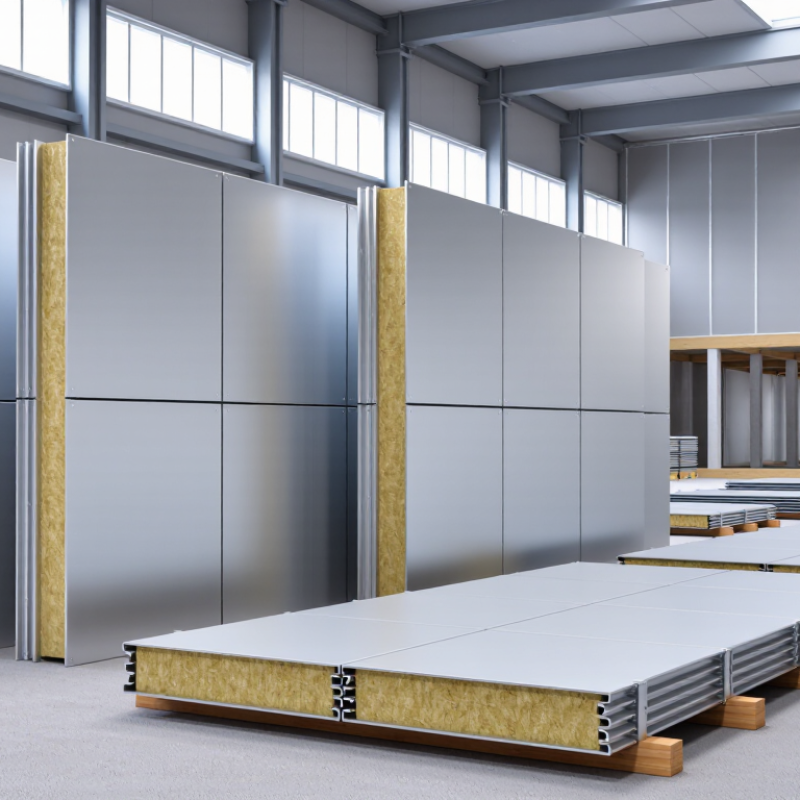
A rock wool sandwich panel is a prefabricated building element with a mineral wool core between two protective metal facings. The core is made from spun volcanic rock and recycled minerals. It reduces heat transfer, absorbs sound, and can resist high temperatures. However, “fireproof” is an imprecise word. Performance depends on the complete panel, joints, coatings, and installation details.
Typical rock wool cores have thermal conductivity near 0.035–0.045 W/m·K, according to technical data commonly reported under EN 13162 testing. Fire classification can reach the highest non-combustible class for suitable mineral wool products, but the finished panel requires separate testing. Buyers should request reaction-to-fire reports, fire-resistance ratings, density, thickness, and factory quality records.
The need is substantial. The 2024 Global Status Report for Buildings and Construction, published by UNEP and GlobalABC, reported that buildings consumed about 32% of global energy in 2023 and produced about 34% of global carbon emissions. A well-designed insulated envelope can reduce heating and cooling demand, especially in warehouses, cold regions, and industrial facilities. Yet thicker insulation is not automatically better. Poorly sealed joints can create cold bridges, condensation, and hidden corrosion. I would check the project climate, span loads, acoustic target, and local code before selecting a panel. Small details matter.
2026 Best Rock Wool Sandwich Panel for Global Buyers?
Key Features and Performance Standards in 2026
In 2026, reliable rock wool sandwich panels must prove more than attractive specifications. Buyers should check thermal conductivity, core density, fire reaction, acoustic control, and joint design. Many panels achieve thermal conductivity near 0.035–0.045 W/m·K, but actual U-values depend on thickness and installation. Fire performance should reference EN 13501-1 or an equivalent national standard. A claimed A2-s1,d0 rating may apply only to a tested assembly, not every configuration.
Moisture resistance deserves equal attention. Tight joints, durable coatings, and tested water penetration performance help protect warehouses and industrial buildings. Wind-load results should match the project’s location, building height, and fixing pattern. Acoustic ratings also need careful reading because laboratory results may differ from site conditions. Field checks often reveal small gaps around corners and fasteners. These details can reduce real performance. A panel may look excellent on paper, yet installation remains the weak point.
Tips: Request third-party test reports, factory quality records, and an Environmental Product Declaration when available. Confirm EN 14509 or the relevant local standard. Ask for full-scale fire evidence, not only core data. Check samples under daylight for coating defects and uneven joints. Do not select by price alone. That shortcut can become expensive.
Choosing the best rock wool sandwich panel for a global project requires more than comparing prices. The International Energy Agency reports that buildings consume about 30% of global final energy. Therefore, panel insulation affects both operating costs and carbon performance.
Check the declared thermal conductivity, usually near 0.034–0.045 W/m·K, but verify the tested value at the expected temperature.
Start with the project climate. A cold warehouse may need thicker cores, while a humid coastal facility needs reliable joint sealing and corrosion-resistant facings.
Review the panel’s density, fire classification, acoustic rating, and load capacity. EN 14509 supports performance evaluation for insulated metal panels, while EN 13501-1 helps classify reaction to fire. North American projects may require ASTM-based testing instead.
A certificate from one region may not satisfy another authority.
Ask for complete technical files. They should include test reports, installation tolerances, environmental product declarations, and maintenance guidance.
The United Nations Environment Programme identifies buildings as responsible for roughly 30% of global energy demand and 26% of energy-related emissions. Small thermal bridges can quietly weaken those targets.
Experienced installers matter as much as the core material. I have seen specifications fail because fasteners and flashings were treated as minor details. That assumption deserves reconsideration.
Also compare embodied carbon, recycled content, warranty terms, and supply distance. The cheapest panel can become expensive after site delays, replacement work, or poor airtightness.
Rock wool sandwich panels are used widely because they combine thermal insulation, sound control, and non-combustible mineral insulation. In warehouses, they help stabilize indoor temperatures around loading areas and storage zones. Fewer temperature swings can protect packaged goods and reduce energy waste. Panel joints still need careful sealing. Small gaps can undermine good materials.
Manufacturing plants often use these panels for production rooms, workshops, and service corridors. Their dense core can reduce noise from compressors, conveyors, and metal equipment. In food processing facilities, smooth coated surfaces support regular cleaning when the complete wall system is correctly specified. However, moisture exposure remains a concern. Damaged coatings or weak joints may allow water into the core.
Commercial buildings, sports halls, schools, and temporary site offices also benefit from rock wool panels. They provide faster enclosure than traditional masonry and reduce disruption during construction. Cold storage projects require extra attention to vapor control and thermal bridges. A panel is not a complete fire strategy. Designers must review thickness, density, joints, penetrations, and tested assemblies together. In practice, project teams sometimes focus on insulation values and overlook installation quality. That mistake deserves more attention. Local climate, building use, maintenance access, and fire regulations should guide every specification. Experienced installers should inspect alignment, fasteners, seals, and edge protection before handover.
| Industry | Common Application | Recommended Panel Role | Typical Rock Wool Core Thickness | Key Performance Requirements | Important Design and Installation Considerations |
|---|---|---|---|---|---|
| Industrial Manufacturing | Factory walls, production halls, workshops and plant extensions | External wall and roof envelope for thermal insulation, fire protection and acoustic control | 50–150 mm | Non-combustible mineral wool core; thermal resistance; impact-resistant outer sheets; reduced reverberation in large halls | Use corrosion-resistant fasteners and properly sealed longitudinal and transverse joints. Final fire performance depends on the complete tested panel assembly. |
| Warehousing and Logistics | Distribution centers, storage warehouses and loading areas | Large-area wall and roof cladding with durable thermal separation | 80–150 mm | Low heat transfer; fire safety; dimensional stability; resistance to daily temperature changes and mechanical wear | Panel thickness should be selected according to local energy codes, indoor temperature, outdoor climate and spacing of structural supports. |
| Food Processing | Processing rooms, packaging areas, ingredient stores and service corridors | Hygienic insulated wall and ceiling system | 80–150 mm | Cleanable surfaces; moisture control; low air leakage; fire resistance; resistance to cleaning chemicals | Specify smooth, washable facings and hygienic joint details. Avoid exposed gaps, unsealed penetrations and water traps. |
| Cold Storage and Refrigeration | Chilled rooms, freezer rooms, refrigerated distribution areas and ante-rooms | Insulated enclosure where fire performance and mineral-wool construction are required | 100–200 mm | Continuous vapor control layer; low air leakage; resistance to condensation; stable performance at low temperatures | Panel joints, corners, doors and service penetrations require carefully designed vapor and airtight seals. Thermal requirements should be verified by calculation. |
| Commercial Buildings | Retail units, office buildings, shopping facilities and mixed-use developments | Lightweight façade, roof and internal partition system | 50–120 mm | Fire safety; appearance; acoustic comfort; thermal performance; compatibility with façade interfaces | Coordinate panel modules with windows, doors, curtain walls, drainage and architectural cladding before fabrication. |
| Data Centers | Server halls, technical rooms, electrical rooms and secure service areas | Fire-resistant internal partitions and external envelope | 80–150 mm | Fire compartmentation; smoke control; acoustic isolation; low air leakage; compatibility with cable and pipe penetrations | All penetrations should use tested fire-stopping systems. Panel selection must match the required fire-resistance period of the wall or ceiling assembly. |
| Agricultural Buildings | Livestock housing, equipment stores, agricultural workshops and crop storage | Durable wall and roof enclosure for variable humidity environments | 50–120 mm | Fire safety; moisture management; corrosion resistance; resistance to impact and aggressive indoor atmospheres | Choose suitable facing materials for ammonia, fertilizer dust, humidity and wash-down conditions. Provide effective ventilation and drainage. |
| Transport Infrastructure | Airport service buildings, railway facilities, maintenance depots and vehicle workshops | Fire-conscious external walls, roofs and acoustic partitions | 80–150 mm | Fire resistance; noise reduction; impact resistance; weather durability; fast installation | Use reinforced details in areas exposed to vehicles, equipment movement or high wind loads. Check structural fixing capacity and panel spans. |
| Energy and Utility Facilities | Substations, boiler rooms, utility plants and renewable-energy service buildings | Fire-resistant enclosure around equipment and operational spaces | 80–150 mm | Non-combustible core; heat resistance; acoustic control; corrosion protection; serviceability | Coordinate ventilation, thermal expansion, equipment clearances and access panels. Select coating systems suitable for the site atmosphere. |
| Modular and Prefabricated Construction | Portable offices, site accommodation, classrooms and temporary facilities | Factory-assembled insulated wall, roof and partition modules | 50–100 mm | Low structural weight; rapid installation; fire performance; thermal comfort; transport durability | Design panel joints for repeated assembly where necessary. Protect edges and corners during lifting, transport and on-site handling. |
| Marine and Offshore Support | Port workshops, marine service buildings and offshore support modules | Insulated partitions and envelopes for harsh, humid environments | 50–120 mm | Fire safety; acoustic insulation; corrosion resistance; moisture control; resistance to vibration | Use compatible protective coatings, sealed joints and corrosion-resistant fixings. Project-specific marine approvals may be required. |
| Cleanrooms and Controlled Environments | Pharmaceutical, electronics and laboratory support areas | Low-leakage wall and ceiling system with smooth, cleanable surfaces | 50–100 mm | Surface cleanliness; airtightness; fire performance; low particle generation; controlled temperature and humidity | Use flush joints, sealed service penetrations and compatible sealants. The complete room system should be validated for the required cleanliness level. |
| Technical note: The thickness ranges are typical preliminary-selection values, not universal specifications. Final panel selection should be based on local building codes, required U-value, fire classification, span and wind loads, humidity exposure, acoustic targets, joint design and the tested performance of the complete panel system. Rock wool core classification and whole-panel performance are not always identical. | |||||
2026 Best Rock Wool Sandwich Panel for Global Buyers?
International buying starts with the approval pathway, not the lowest quotation. The UNEP Global Status Report for Buildings and Construction 2023 states that buildings consume about 32% of global energy and generate approximately 34% of global CO2 emissions. Rock wool panels can support lower heat loss, but buyers should request verified thermal conductivity, density, thickness, and fire-performance data. For European projects, EN 14509 and EN 13501-1 are common references. Other markets may require ASTM E84, ASTM E119, or local fire codes. Certificates should come from laboratories accredited to ISO/IEC 17025. Check the exact assembly, not only the core material.
Details matter during procurement. Ask for dimensional tolerances, coating specifications, corrosion classification under ISO 12944, and an environmental product declaration based on ISO 14025 and EN 15804. Confirm the HS code with a customs broker before shipment. Small errors can delay a container.
Installation quality often decides actual performance. Keep panels dry, protect cut edges, and seal longitudinal joints continuously. Fastener spacing must reflect local wind loads, panel span, and substrate strength. Poorly compressed washers can admit rain. Missing vapor control can create condensation inside a cold-room wall. I have seen drawings look correct while site tolerances caused visible gaps. That is uncomfortable, but realistic. A pre-installation mock-up and thermal-bridge review are worth the extra day. Product data cannot repair careless alignment.
Estimated thermal performance by panel thickness for international purchasing, certification review, and installation planning.
The estimated center-of-panel U-values are calculated from a nominal rock wool design thermal conductivity of 0.040 W/m·K using U ≈ λ / thickness. Lower U-values indicate better thermal insulation. Actual declared values depend on product density, joints, fasteners, moisture, fire classification, and laboratory testing. Buyers should verify performance according to EN 14509, thermal calculations based on ISO 6946, and fire classification under EN 13501-1 or the applicable local standard.


